Money is one of the first things that trips people up in Prague. The Czech Republic is in the European Union but doesn’t use the euro: its currency is the Czech koruna, or crown (CZK). That confuses plenty of visitors who arrive expecting to pay in euros. You can in some places, but it costs you. Here’s what you really need to know about currency exchange in Prague so you don’t lose money.
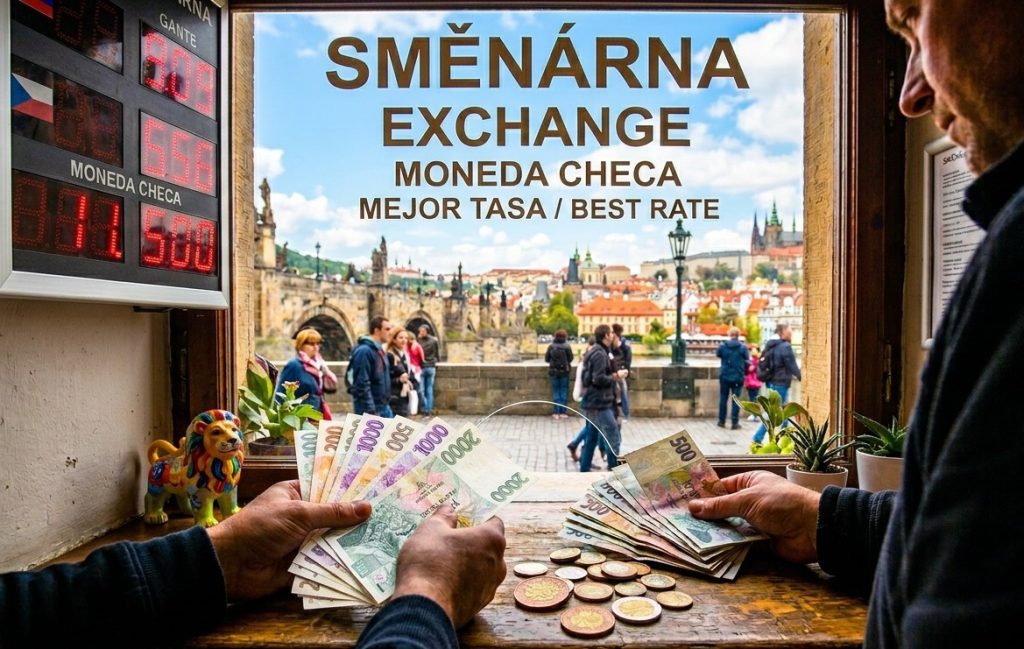
The Czech koruna (CZK)
Some very touristy hotels and restaurants accept euros, but the rate they give you is usually much worse than the official one. The simplest thing is to always pay in koruna. The most common banknotes are 100, 200, 500, 1,000, 2,000 and 5,000 CZK, and in 2026 the rate is around 1 EUR ≈ 24.5 CZK. Rates move, so check the current rate for your own currency before you travel.
Where to exchange money in Prague without getting scammed
Exchange offices are not all the same, not even close. Avoid the ones at the airport and train stations: their fees can eat up to 20% of what you change. Some options that work well:
- Exchange s.r.o. (Štefánikova 203/23): probably the best known among travelers, with rates very close to the Czech National Bank’s official rate.
- Nekázanka Exchange (Nekázanka 884/10): transparent, with competitive rates.
- Alfa Prague (Na Příkopě 957/23): near Wenceslas Square, with pretty decent terms.
Before you hand over your money, ask directly: “How many koruna will I get in total?” A “0% Commission” sign doesn’t guarantee anything; sometimes the margin is hidden in the exchange rate itself.
Can you pay by card in Prague?
In 2026, Prague is practically cashless. You can pay by card or phone almost everywhere, from museums to the smallest café. Travel-friendly cards such as Revolut or Wise usually give you the interbank rate with no extra fees, and that’s the most convenient option for day-to-day spending. If you use your regular bank card, check whether it charges foreign transaction fees before you go.
If you need cash, use ATMs from official banks (KB, ČSOB, Česká spořitelna). The blue-and-yellow Euronet ATMs charge pretty outrageous fees, so it’s best to avoid them.
The “pay in your own currency” trap
When you pay by card or withdraw cash, you’ll often be asked whether you want to pay in your home currency or in Czech koruna. Always choose koruna. If you choose your home currency, the shop or bank applies its own exchange rate (known as DCC, dynamic currency conversion), which is usually 5–10% more expensive than your own bank’s rate.
Never change money on the street
This isn’t just advice, it’s a serious warning: never change money with strangers who approach you on the street, however good the rate sounds. It’s a well-known scam. Sometimes they hand over fake bills or bills no longer in circulation, or even banknotes from another country (there have been cases involving old, worthless Belarusian rubles). Street money changing is also illegal.
Quick summary
- Use a travel card (Revolut, Wise…) or a card with no foreign transaction fees for most payments.
- If you want some cash, change a small amount (around €50–100 worth) at a reliable office like Exchange s.r.o.
- Stay away from the blue-and-yellow ATMs in tourist areas.
- Always decline automatic conversion to your home currency at the card terminal.
For other scams to watch out for, read our guide on whether Prague is safe for tourists.