Old Town Square is the historic heart of Prague, and its centerpiece, the Prague Astronomical Clock, is probably the most photographed thing in the whole city. Here’s its history, how it works, when to catch the parade of figures and a couple of legends hardly anyone knows.
Old Town Square: from medieval market to the heart of Prague
Long before the Astronomical Clock existed, the square was already the center of the city. Its origins go back to the 10th century, when a market grew up where several European trade routes met, next to an old customs house where goods arriving in Prague were cleared. A hospital with the Church of the Virgin Mary, inns and stables were built to serve foreign merchants. By 1100 there are records of a market held here every Saturday, selling everything from imported cloth (in permanent stone stalls next to the town hall tower) to mushrooms, strawberries, game, vegetables, butter and cheese. The first Romanesque and Gothic houses went up around the square in the 12th and 13th centuries, and in the mid-13th century the ground level was raised significantly to protect against floods, burying the original ground floors below today’s street level. The square remained Prague’s main market until the early 20th century, and in 1338 the Old Town Hall was founded here, the beginning of the building that houses the clock today.
History of the Prague Astronomical Clock
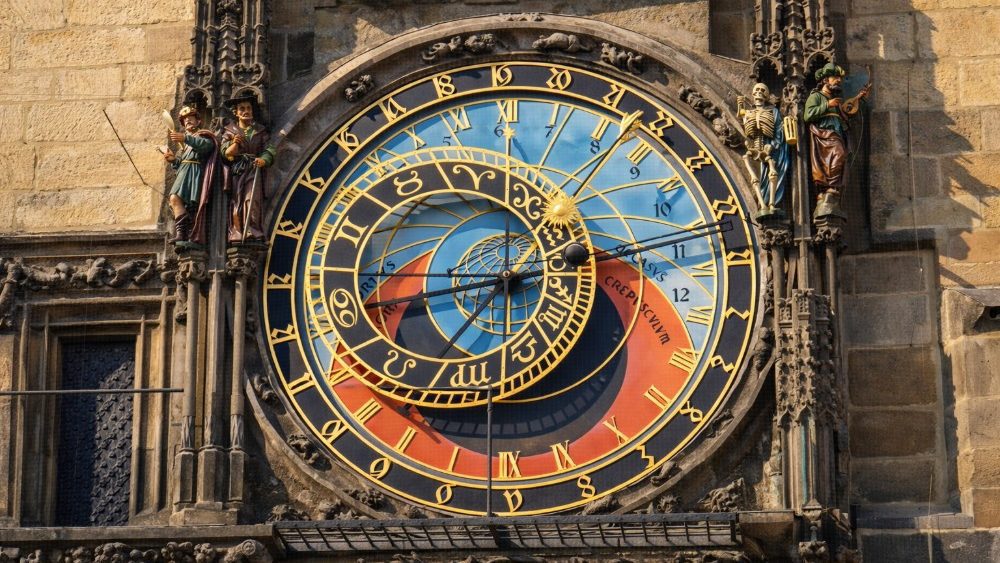
The clock was first installed in 1410, making it the oldest astronomical clock in the world that still works. Over the centuries it was repaired and expanded: the calendar dial was added in the 17th century and the apostle figures in the 19th. It was badly damaged in the last days of World War II, in May 1945, when a fire started by German troops destroyed much of the town hall and the clock’s original wooden figures. It was restored in the following years and still runs today with much of its historic mechanism.
How the Astronomical Clock works: three parts, three jobs
- The astronomical dial (top): besides the time, it shows the position of the sun and moon in the zodiac, based on the medieval geocentric model with the Earth at the center. A small silver-and-black sphere turns to show the phases of the moon in real time.
- The Walk of the Apostles: every hour on the hour, from 9:00 a.m. to 9:00 p.m. (9:00 a.m. to 8:00 p.m. in winter), two small windows open and the 12 apostles file past while a skeleton, representing Death, rings a bell and turns an hourglass. Next to it, other figures represent Vanity, Greed and Lust, each with its own symbolic gesture.
- The calendar dial (bottom): dating from the 19th century and painted by Josef Mánes, it shows the farm work of each season. The center shows the Old Town coat of arms, surrounded by the signs of the zodiac.
The legend of Master Hanuš
Legend has it that once the clock was finished, the city council, afraid the clockmaker would build a copy somewhere else, had him blinded. In revenge, Hanuš threw himself into the mechanism, stopping it for decades and cursing anyone who tried to repair it. There’s no historical evidence that any of this happened (modern research points to Mikuláš of Kadaň as the real builder, and the Hanuš story only became popular centuries later), but it’s part of the city’s folklore, and every guide will tell it to you in full detail.
What else to see on Old Town Square
Around the square you’ll find the Church of Our Lady before Týn with its pointed Gothic spires, St. Nicholas Church, and the monument to Jan Hus, the 15th-century religious reformer burned at the stake as a heretic. He’s considered one of the forerunners of the Protestant Reformation, a century before Luther. The square is also where most free walking tours of the city start, and where Prague’s biggest Christmas market sets up every December.
Tips for your visit
- The apostles show only lasts a few seconds. Look away just before the hour and you’ll miss it.
- The square gets very busy around midday. Go early in the morning if you want it to yourself.
- You can go up the Old Town Hall Tower, where the clock is, to see it up close and get great views of the square. There’s an elevator, so you don’t have to climb the stairs.
- A lot of visitors find the show itself a bit underwhelming because it’s so short. The real interest is in the mechanics and symbolism of the whole clock, which a guide explains much better.
- Important: watch out for pickpockets. Old Town Square is one of their favorite spots.
Our advice
To really understand the clock’s history and legends, go with a local guide. The free walking tour of the Old Town and the Jewish Quarter starts right here. If you’re planning the rest of your visit, take a look at our Prague itinerary for 2, 3 or 4 days.